EU Score: adtech sovereignty finally measurable
12/06/2026 |
Cloud, large language models, messaging apps… The debate on European digital sovereignty is expanding to an ever-growing list of topics. It comes as no surprise, then, to see adtech covered by initiatives such as EU Score — a platform that is also the flagship of a European digital resistance movement.
A Wikipedia-inspired model
Number of employees based in the European Union, share of European ownership in the capital structure, registered office location… These are just some of the data points available on the EU Score database, for players that — like Commanders Act — are listed on the platform. Among those players: hosting providers, CRM applications, collaboration tools and adtech solutions. “We think more in terms of software capabilities than actor categories,” explains Olivier Rohou, co-initiator of the project.
The site eu-score.tech is in fact the visible part of a movement launched on 18 June 2025. “The date is not arbitrary,” notes Olivier Rohou, “since this is a European digital resistance movement. It is also a movement that defines itself as techno-progressive in the face of Trumpist drift. Within this movement, EU Score plays a dual role: preventing ‘sovereignty washing’ and counting the real European forces in play.”
The model draws its inspiration from Wikipedia. Currently published by an association (which could evolve into a foundation depending on future fundraising), the platform is designed to be highly open. “Anyone can create a company profile, while employees with a company email address can request modifications to information. Of course, we have been careful to define moderator roles, deploy verification bots and ask questions with enough granularity to make dishonesty very visible,” explains Olivier Rohou, who also emphasises his ambition for independence.
Objective: making buyers accountable on sovereignty issues
“We do not sell consulting and have no intention of doing so. Our goal is to make EU Score a standard, the way the Nutri-Score is today. And like the Nutri-Score, EU Score may evolve — but always while remaining simple to understand.” A key readability for directing users, B2B buyers, public procurement and investors towards credible European players.
“The spirit of the project is not one of a boycott call,” stresses Olivier Rohou. “EU Score wants to make the purchasing act more accountable. Moreover, the platform is open to non-European players.”
Another ambition of the platform: facilitating convergence between European players to improve their capacity to invest at the same pace as their international competitors.
Adtech at the heart of sovereignty issues
Unsurprisingly, adtech solutions are particularly eligible for this kind of assessment. The quest for sovereignty runs as an undercurrent through all the techno-regulatory developments of recent years. The valorisation of first-party data, dependency on browsers and walled gardens, the GDPR, server-side tracking… Each of these topics points back to sovereignty issues relating to control over data, from collection to lifecycle management.
These issues are of course already well known to European brands that already invest in the European adtech ecosystem. And these solutions — including those published by Commanders Act — attract German, French, Italian and Spanish brands, as well as major American ones.
In this landscape, EU Score opens up another dimension: the sovereignty of software infrastructure — a subject that, in other domains such as cloud, has given rise to players positioning themselves as “trusted cloud” providers (such as S3NS) or sovereign ones (such as Scaleway).
7 sovereignty criteria
To objectify this quality of “sovereign European solution”, EU Score relies on several criteria that evolve regularly thanks to the community:
| Criterion | Description |
|---|---|
| Registered office | Legal location of the company. |
| Employees | Headcount reported country by country, without globalising percentages. |
| Investors | Detailed capital structure, shareholder by shareholder, with nationalities and stakes. |
| Subcontractors | Composition of the subcontracting chain. |
| Values | DEI (diversity, equity, inclusion) and ESG commitments. |
| Servers | Geographic location and nationality of the hosting provider. |
| Source code | Code ownership, status and actual level of open source.Note: this criterion was recently added to prevent “open source washing”. |
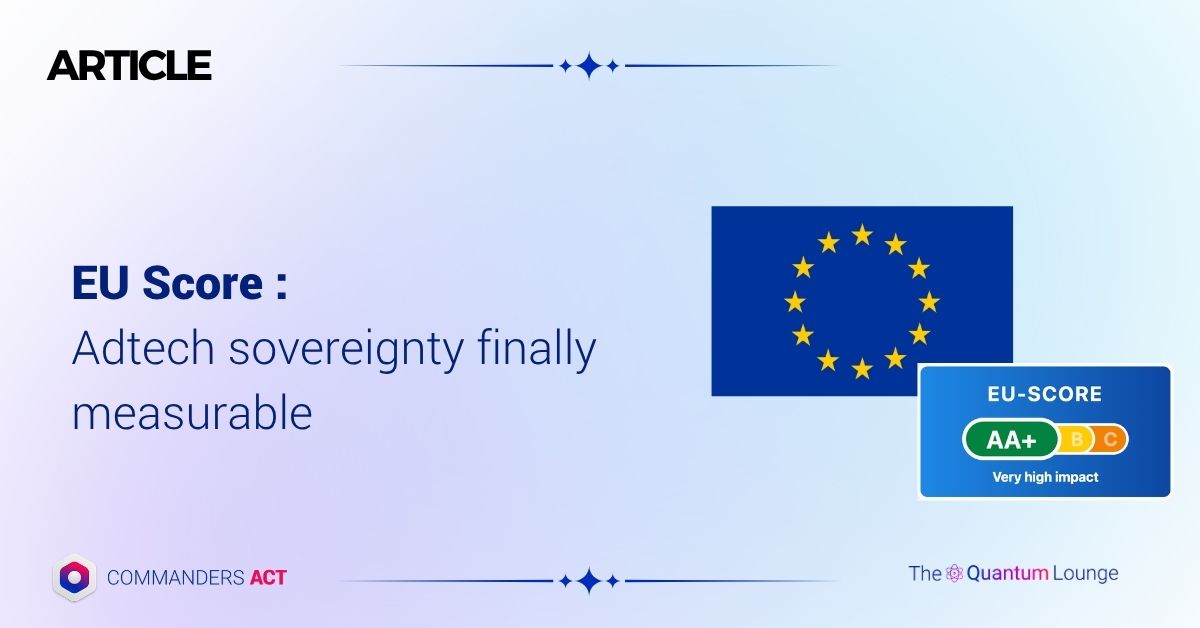
Once the data has been entered, each solution receives a number of points that translates into a rating, from C to AAA. The whole system has been designed to encourage data completion and precision: the more data a company provides, the higher its score climbs. “Transparency pays,” as Olivier Rohou puts it. And this is precisely what motivates publishers. “There have been many initiatives historically, but EU Score’s approach is far more relevant,” says Michael Froment. “It does not consist in waving a marketing flag, but in getting into the details of what actually constitutes sovereignty.”
An overall score modelled on the Nutri-Score
How is an EU Score read? Let’s take a concrete example. The Commanders Act profile currently shows 563 points and an AA+ rating on the framework. Concretely, the seven criteria have been completed with a high level of detail: breakdown of employees across Europe, capital structure, registered office location, documentation of the subcontracting chain…
Worth noting: the score can be embedded via a badge and can therefore be installed on the publisher’s website, updated in real time.
2,000 solutions listed
Today, more than 2,000 solutions are listed on eu-score.tech — approximately two thirds of European SaaS solutions, estimated at around 3,000, out of a global total of around 30,000.
The context works in the framework’s favour. “Many citizens believe that Signal or Claude are European — or even French,” notes Olivier Rohou. “And at the same time, we are seeing a genuine interest emerging for sovereign solutions.” Indeed, European B2B buyers are increasingly asking questions about the sovereignty of their providers — a trend that has accelerated since Donald Trump’s second term. Public procurement is also beginning to integrate these criteria.
For marketing and data teams, this quest for sovereignty is already under way and is moving with the tide of history. The challenge is no longer simply to choose the best adtech solution on functional, technical and budgetary criteria. It is also about conducting a risk analysis on this topic — as on others — in light of the international landscape. With the right questions to ask: where do data flows go? Who really controls the consent, tracking and attribution building blocks? And: how many years before the next unilateral decision by a non-European player reconfigures the measurement chain?
EU Score does not provide all the answers. It provides a measurable entry point, and a common language for bringing adtech into the European debate on sovereignty.