
Your first-party data is worth more than your media budget
22/04/2026 |
40% of digital advertising spend never reaches its target. Meanwhile, companies that structure their first-party data collection report revenue growth 2.9 times higher than their peers. What if the real strategic asset isn’t the budget you spend, but the data you own?
40% of digital ad spend wasted?
“Half the money I spend on advertising is wasted; the trouble is I don’t know which half.” This quote from John Wanamaker — pioneer of the modern department store and of advertising itself — dates back to the early twentieth century. It pointed to a very rudimentary way of measuring advertising effectiveness. The paradox: more than a century later, as advertising has gone largely digital and given birth to a dedicated industry — adtech — this observation could still be made by many a CMO today.
It was the ANA’s (Association of National Advertisers) Programmatic Transparency Benchmark Study that put the issue in the spotlight in 2023, estimating at the time that only 36% of programmatic investment actually reached consumers. The situation has since improved, with a recovery in TrueAdSpend — an indicator that measures, for every dollar spent on digital advertising, the share that genuinely reaches consumers in the form of a viewable impression.
TrueAdSpend has risen from 43.9% in 2024 to 57.6% in the last quarter of 2025 (see the latest edition of the report) for the best-performing advertisers. In short, the “black hole of ad spend” currently stands at a minimum of around 40%.
First-party data: the anti-waste formula?
It is worth noting that in France, online advertising investment in 2025 reached €12.4 billion according to the Syndicat des Régies Internet (SRI 2025 Report, in french). Waste at 40% therefore represents nearly €5 billion. The reasons are well known. The real question is: is this waste inevitable?
Good news: a solution exists, and it too is well known — first-party data. Brands are increasingly paying attention to it, for two reasons:
- Because advertising inflation and the fragmentation of audiences across multiple platforms is making new customer acquisition increasingly expensive. For 2026, advertising cost inflation of around +3% is expected (this is a global average; the figure will be higher for online advertising).
- Because brands that bet on first-party data come out ahead. This is already the case for 40% of Commanders Act’s clients, who have seen higher conversion rates thanks to better personalisation, improved retention rates, and increases in average order value.
The lesson is clear: performance no longer depends solely on how much you invest in media, but also on the data you own, its quality, and what you do with it.
What the Walled Gardens understood before you did
This lesson is one that Google, Meta, and Amazon understood long ago — together they capture 76% of the online advertising market in France. Their power is of course tied to the scale of their inventory. But not only that: a Google search, an Instagram scroll, an Amazon order — every interaction feeds a proprietary asset. And within these Walled Gardens, third-party data simply does not exist. Everything is first-party.
Brands also have a proprietary ecosystem: website, application, CRM, stores, loyalty programme… But where platforms treat every interaction as an investment in their data capital, too many advertisers still manage first-party data as a by-product of tracking — or in silos — rather than as a globally managed asset.
Going all-in on first-party and zero-party data
And yet brands that have launched first-party or zero-party data initiatives (data voluntarily shared by a customer during a direct interaction with the brand) are seeing very tangible gains.
- L’Oréal has multiplied its proprietary experiences, making extensive use of online diagnostics and augmented reality. These are services for which users are willing to share data that subsequently proves valuable for personalising messages and improving conversions.
- Sephora has invested heavily in its CRM at an omnichannel scale (email, app, stores) to target audiences without relying on cookies. This more qualitative targeting has delivered, among other things, higher customer retention.
- McDonald’s, for its part, is betting on its app and digital loyalty programme — a direct channel with customers that enables far more effective personalisation and, ultimately, a higher average order value.
| Criteria | Zero-party dataVoluntarily declared | First-party dataCollected directly | Second-party dataShared by a partner | Third-party dataPurchased / aggregator |
|---|---|---|---|---|
| Definition | Data proactively and voluntarily shared by the user (preferences, purchase intent via quizzes or surveys). | Data collected directly by the company through its own channels (website, app, CRM, behavioural data). | A partner’s first-party data shared contractually (e.g. supplier / distributor). | Data purchased from or provided by a third-party aggregator (via third-party cookies or data marketplaces). |
| Consent | ✔✔ Always explicit and voluntary. | ✔ With consent (GDPR required). | ◎ With partner’s consent. | ✘ Poorly controlled. |
| Reliability | ✔✔ Very high (intentional). | ✔ High (proprietary). | ✔ High (controlled source). | ✘ Low. |
| Advantages | Fine-grained personalisation, strong engagement. | Full control, privacy-friendly. | Complementary data enrichment. | High volume, broad reach. |
| Drawbacks | Requires active user interaction. | Limited to own ecosystem. | Dependency on the partner. | ⚠ Deprecated (end of third-party cookies), GDPR risk. |
| Example | Product preference quiz, augmented reality (AR) experience. | Purchases on an e-commerce website. | Distributor data shared with a distributed brand’s own data. | Behavioural data collected through an ad network. |
GDPR: General Data Protection Regulation | CRM: Customer Relationship Management | AR: Augmented Reality
Media budget (OPEX) or data capital (CAPEX)?
Everything points to nurturing this first-party capital. A media budget is, first and foremost, an operating expense (OPEX). Once the campaign is over and the budget spent, nothing more will happen. P&G demonstrated this starkly: the group cut $200 million in digital advertising and reduced its agency roster. Impact on sales? None — because a large share of that budget was feeding poorly qualified audiences.
First-party data follows the opposite logic, resembling a capital investment (CAPEX). Every euro dedicated to its collection — server-side tracking, compliant consent, CRM enrichment — grows a data asset. A customer identified today can be reactivated in six months as a Lookalike on Meta, via Enhanced Conversions on Google Ads, through on-site personalisation, or via loyalty emails. This data does not wear out. On the contrary, it appreciates as it is enriched.
The results confirm this. According to the BCG report already cited: personalisation based on proprietary data generates an advertising return on investment (ROAS) 5 to 8 times higher than traditional methods. The first-party data lever is far from marginal. Here are three scenarios to illustrate.
First-party data in action: three scenarios
Scenario #1: recovering invisible conversions
A retailer invests €500k per month in digital acquisition. The problem: around 35% of its conversions never reach the advertising platforms. The culprits include ad blocker interference (32% of European internet users use one), Safari ITP restrictions, and a lack of consent. As a result, Meta and Google optimise campaigns on a signal that is missing a third of its data, and end up targeting the wrong profiles.
By leveraging server-side and first-party tracking, this retailer recovers more than 30% of its data. The signal becomes more reliable, Lookalike audiences sharpen, and acquisition costs fall by 15 to 20%. The budget has not changed — it is the quality of the data that has improved budget allocation. profiles.
Scenario #2: turning the CRM into an advertising lever
A multichannel retailer has 800,000 customers in its CRM database, complete with purchase histories, product preferences, and loyalty scores. This is high-potential first-party data — provided it is extracted from its silo. By activating this data via server-side connectors (Customer Match on Google, Custom Audiences and CAPI on Meta), the brand enriches every conversion signal.
Instead of transmitting a simple “purchase” event, it shares a much richer piece of information: “€120 purchase, loyal customer for 3 years, premium segment”, and so on. The platforms’ AI then learns to target high-value profiles. ROAS improves by +20% and the share of wasted ad spend falls. Better still, CRM segments continue to be enriched with every interaction — a virtuous circle.
Scenario #3: tracking the offline impact of online campaigns
A retail player invests in digital advertising to drive in-store footfall. Without unified first-party data, it is difficult to link an ad impression to a point-of-sale purchase. By reconciling cross-channel journeys using a Master ID (an anonymous, persistent identifier), it becomes possible to connect the ad click to the in-store transaction.
The measurable result: offline revenue attributable to an online campaign is multiplied by 6, with an uplift (incremental gain associated with the campaign) measured at up to 60%. First-party data is not limited to digital optimisation. It reveals the value of the entire customer journey and gives CMOs the means to justify investment in a first-party data infrastructure.
First-party data: a sovereign asset in service of CLTV
These anonymised but real-world scenarios illustrate the point: investment in first-party data is not played out over a single campaign, but across a series of scenarios. The equation for evaluating the annual value attributed to first-party data can be summarised as follows:
Annual FD value = ∑(incremental gain per scenario − implementation cost) − global amortisation and maintenance cost of the first-party data infrastructure.
An equation that nonetheless gives only a partial view, because the benefits of first-party data operate on several levels:
| Benefit | Indicator | Formula | Explanation |
|---|---|---|---|
| Incremental revenue | Additional turnover |
activated traffic
×conversion rate uplift
×average order value
|
The better the data improves personalisation, the higher the revenue |
| Media efficiency | CAC / CPA savings |
converted volumes
×CPA reduction
|
Data reduces waste and improves targeting |
| Retention | CLTV value |
retained customers
×customer margin
|
CRM audiences and loyalty activation extend customer lifetime |
| Measurement | Arbitrage value |
reallocated budget
×ROAS gains
|
Better measurement enables budget to shift towards the best-performing channels |
CAC: customer acquisition cost | CPA: cost per action | CLTV: Customer Lifetime Value | ROAS: Return on Ad Spend
These benefits carry even greater weight in a context where advertising inflation shows no sign of abating. Pegging your performance solely to media budget volume means exposing yourself heavily to pressure from both the advertising market and regulation. And this exposure creates strong dependencies, as the end of third-party cookies illustrates. In this landscape, the first-party cookie is the new foundation of value, and first-party data represents a sovereign asset — independent of platforms, and one whose value grows with every customer interaction.
From collection to activation, from activation to performance measurement, first-party data is your most valuable asset.
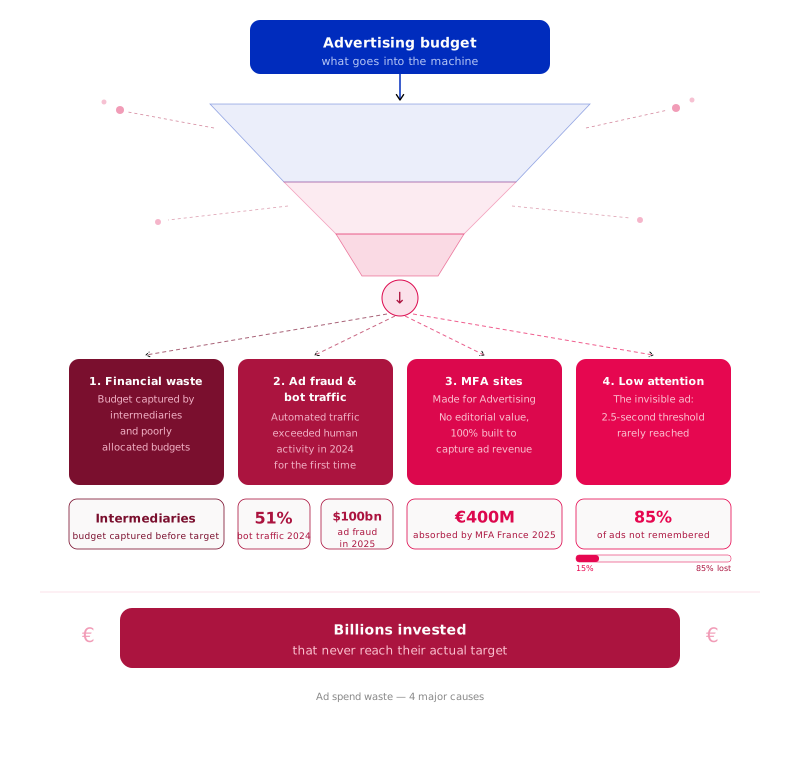
Ad spend waste: 4 main sources
- Financial waste. In other words, budget consumed by intermediaries and poorly allocated spend.
- Ad fraud and automated traffic. For the first time in 2024, automated traffic exceeded human activity on the web, accounting for 51% of total traffic. As for fraud, it is estimated at $100 billion in 2025.
- MFA sites (Made for Advertising). These sites, designed solely to capture advertising revenue with no editorial value, represent a major source of inefficiency. In 2025, more than €400 million in advertising investment will be absorbed by MFA sites in France.
- Low effective perception by users. 85% of online ads fail to cross the 2.5-second attention threshold and therefore leave little impression.
First-party data: 3 questions answered
What is first-party data?
It refers to the data a brand collects directly from its own audiences through its own channels: website, app, CRM, point of sale, email, customer support, etc.
Why is first-party data so sought-after?
This data is considered more reliable, more compliant, and more actionable than third-party data, because it comes from a direct relationship between the brand and the user. Moreover, this data is owned by the brand and therefore comes at a controlled cost.
What are the main types of first-party data?
Three main families of first-party data are commonly distinguished:
Behavioural (pages viewed, visit frequency, emails opened, browsing journeys…)
Transactional (purchases, CRM history)
Declarative (preferences, completed forms)
Find more about the First-party data collection & Server-Side distribution with our Platform X