
How to improve your consent rate: key takeaways from our Privacy Barometer 2026
15/06/2026 |
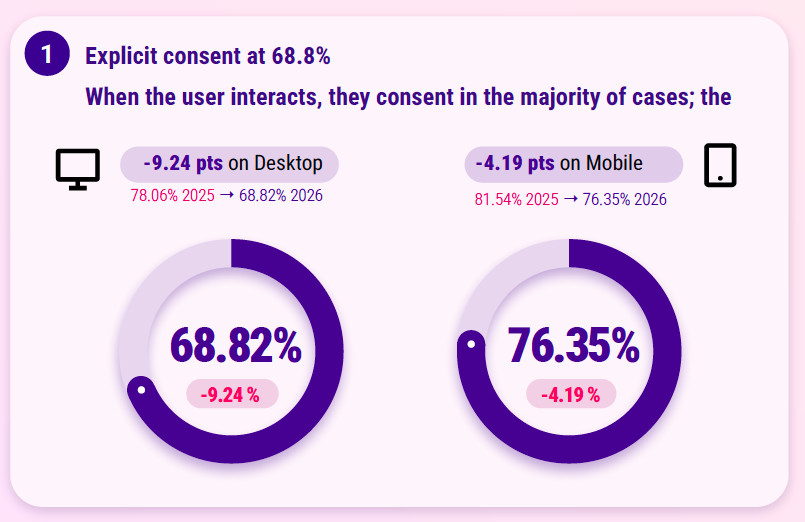
Consent figures are surprising, but not for the reasons you might think. Our Privacy Barometer 2026 reveals an encouraging paradox: when a user interacts with a consent banner, they accept it 68.82% of the time on desktop and 76.35% on mobile. More than 2 visitors out of 3. A clear majority, with no ambiguity.
So the problem is not the willingness to consent. It is engagement, and that is excellent news, because engagement can be worked on. This edition of the barometer, based on the analysis of 2,391 real CMP configurations across all sectors and regions, identifies precisely why users don’t interact, and offers 12 concrete recommendations, deployable within a few weeks, to improve your consent rate. Here are the key takeaways, and above all what you can do with them.
No-Choice: understanding the real challenge
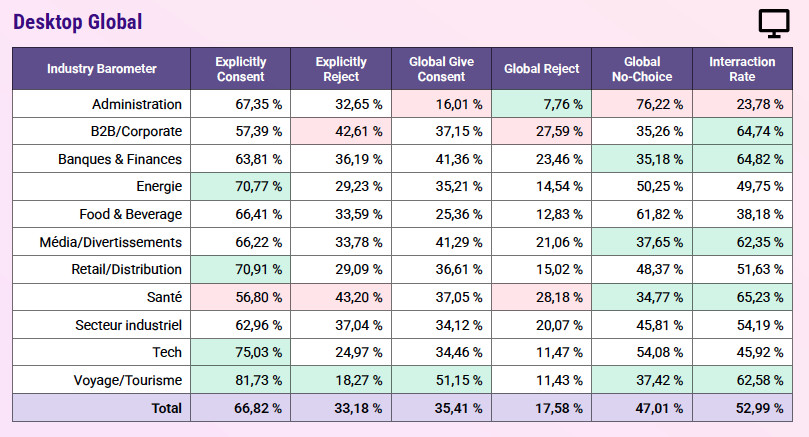
Behind the decline in global consent rates lies a phenomenon more subtle than refusal: indifference. In 2026, 47.01% of desktop visitors generate no consent signal at all, neither acceptance nor refusal. This is what we call No-Choice. This behavior is up 7.74 points compared to 2025, and it is now the majority on desktop.
The good news: a No-Choice visitor is not a hostile visitor. It is a visitor who was not reached at the right moment, in the right context. And that can be fixed.
Four structural factors behind the 2026 consent rates
Striking sector-by-sector disparities
The sector data reveals that the industry sector matters as much as the chosen template for a CMP’s performance.
Sectors with strong purchase or usage intent perform noticeably better. Travel/Tourism shows the highest explicit consent rate on desktop at 81.73%: a user who comes to book a trip is naturally more attentive and more inclined to confirm their choices. Conversely, sectors with passive consumption accumulate No-Choice and low global consent.
Public administration shows the highest No-Choice (76.22%): a poorly engaged institutional audience and often automated visits. The Food & Beverage sector combines passively consumed content with particularly low global consent.
On mobile, the dynamics differ. B2B/Corporate shows a very low No-Choice at 27.05%, proof that good CMP configuration can offset structural constraints when the audience is in “active search” mode.
France vs international: the French specificity
The French market accounts for 86% of desktop impressions and 82% of mobile impressions within our study scope.
On desktop, international markets outperform France on global consent (42.32% vs 34.28%) and show less No-Choice (43.88% vs 47.53%). This is probably explained by better adoption of popin formats outside France.
On mobile, however, France regains the advantage on global consent (46.06% vs 45.85%) and on interaction rate (61.19% vs 56.10%), a sign that the mobile formats deployed in France are better optimized.
The stronger GDPR sensitivity in France systematically translates into a higher rejection rate on both platforms. This is not inevitable: it is a signal that banners need to be perceived as more balanced and less intrusive.
Four areas of action to improve your consent rate
In response to these trends, our barometer identifies four areas that structure an action plan to improve your consent rate.
The strategy to adopt: improve your consent rate based on your sector
The conclusion of this 2026 edition can be summed up in one sentence: your industry sector should not determine CMP performance, it should determine CMP strategy.
There is no single universal good CMP. There are CMPs suited to their context. A Food & Beverage site with passive content does not apply the same levers as a Travel/Tourism site with strong transactional engagement. The data proves it, with a 41-point No-Choice gap on desktop between public administration and B2B/Corporate.
The good news: none of the recommendations identified in this barometer requires a complete overhaul. Most can be deployed within a few weeks. The obstacle is not technical: it is prioritization.
The full study, in figures and charts
This article has given you the broad strokes. The Privacy Barometer 2026 goes much further: complete data tables by sector and region, desktop/mobile comparisons by template (footer, popin, IAB TCF [LINK: cnil.fr TCF definition — keep or swap for the IAB official EN page]), an analysis of GCM impact, and chart visualizations that make the trends immediately readable. Plus 12 concrete recommendations to improve your consent rate, deployable within a few weeks, without overhauling your CMP.